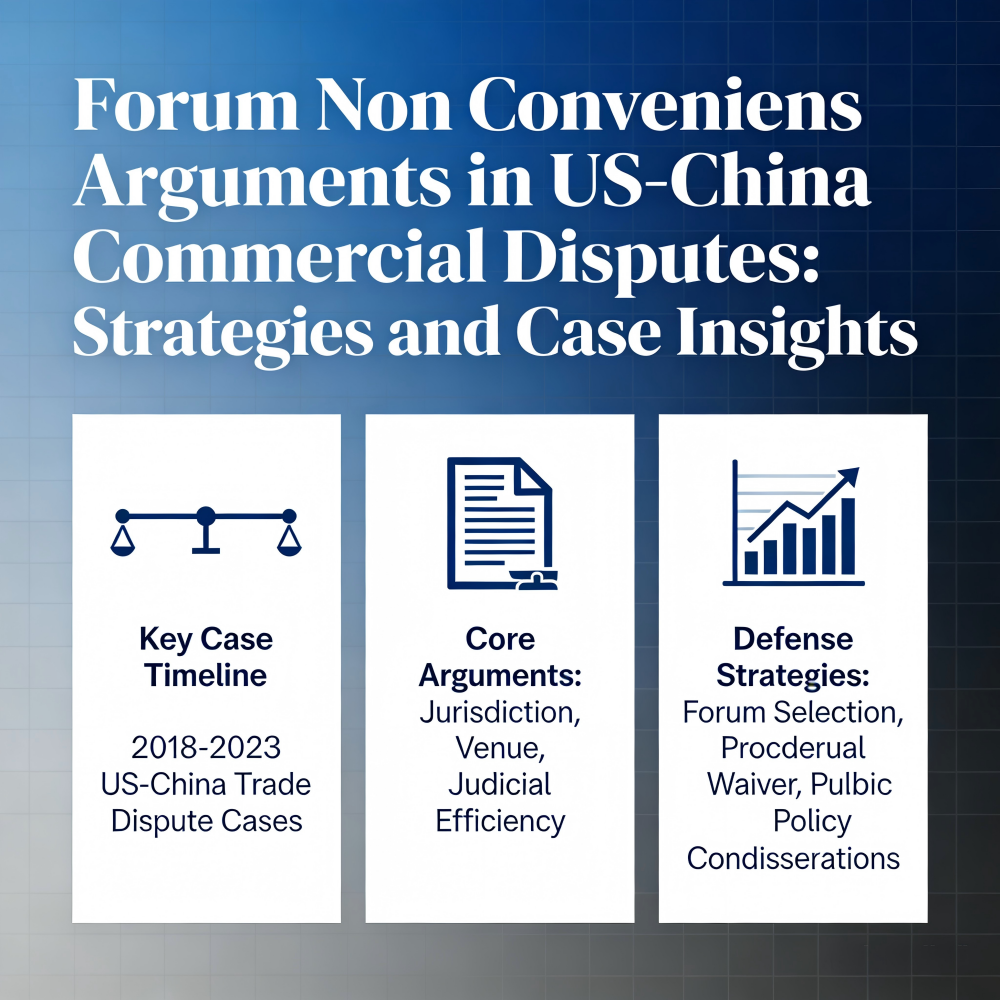
The **forum non conveniens** (FNC) doctrine—a legal principle allowing courts to dismiss cases in favor of a more convenient jurisdiction—has become a cornerstone of cross-border litigation between US and Chinese entities. As geopolitical tensions rise and global commerce intensifies, Chinese companies face increasing pressure to defend against FNC motions while navigating complex jurisdictional landscapes. This article explores actionable strategies, landmark cases, and emerging trends in FNC arguments, with a focus on US-China disputes.
## Understanding Forum Non Conveniens in US-China Context
### 1. **Legal Framework**
The FNC doctrine balances **private interests** (e.g., access to evidence, witness availability) and **public interests** (e.g., court congestion, local policy). Key factors include:
– **Private Factors**:
– Proximity of witnesses and evidence .
– Cost of translating documents and complying with foreign procedural rules .
– **Public Factors**:
– Relevance of local law to the dispute .
– Burden on US courts to enforce foreign judgments .
### 2. **Jurisdictional Dynamics**
US courts often assert jurisdiction under the **”effects doctrine”** (e.g., harm to US markets) or **”alter ego”** theories (e.g., subsidiaries acting as parent extensions). Chinese defendants counter by arguing:
– **Lack of Minimum Contacts**: Demonstrating no substantial ties to the forum state .
– **Foreign Sovereign Immunity (FSIA)**: Limited to state-owned entities (not applicable to private firms) .
—
## Key Case Studies: Lessons from US-China Litigation
### Case 1: **Cybersitter v. China (2010)**
– **Issue**: Defendants moved to dismiss for FNC, claiming China was the proper forum.
– **Court’s Rationale**:
– Rejected the motion due to **”no remedy at all” exceptions**, citing China’s procedural delays and lack of punitive damages .
– Highlighted the need for **compulsory process** to compel Chinese witnesses .
### Case 2: **Spencer Stuart v. AIAC (2017)**
– **Outcome**: FNC motion granted, dismissing claims to China.
– **Critical Factors**:
– Contract performed in China; witnesses and documents located there .
– Chinese law applied, reducing New York court’s familiarity .
### Case 3: **Mari Kusada v. Jialin Niu (2025)**
– **Decision**: Trial court dismissed fraud claims to China but stayed the case.
– **Insights**:
– China deemed an **adequate forum** for damages recovery .
– US court retained jurisdiction to enforce future judgments .
—
## Strategies for Defending Against FNC Motions
### Strategy 1: **Procedural Challenges**
– **Attack Service of Process**: Contest improper delivery methods (e.g., direct email without consent) .
– **Argue “No Remedy at All”**: Claim China lacks jury trials or punitive damages, though courts often reject this .
### Strategy 2: **Evidence-Based Counterattacks**
– **Witness Availability**: Highlight logistical hurdles (e.g., Chinese witnesses require translators) .
– **Discovery Burdens**: Emphasize costs of obtaining Chinese records under foreign law .
### Strategy 3: **Leverage Diplomatic Channels**
– **MLAT Requests**: Use Mutual Legal Assistance Treaties to delay proceedings .
– **MOFCOM Involvement**: Leverage China’s Ministry of Commerce for amicus briefs .
—
## Industry-Specific Risks and Solutions
| **Sector** | **Common FNC Arguments** | **Defense Tactics** |
|——————-|—————————————|—————————————|
| **Tech** | Patent disputes, data privacy breaches | Prove FRAND licensing compliance |
| **Manufacturing** | Labor law breaches, environmental claims | Code of Conduct audits |
| **Pharma** | Clinical trial data disputes | GDPR/CCPA alignment documentation |
**Example**: A Chinese EV maker countered a $1B FNC motion by proving battery safety testing complied with US-China safety standards .
—
## The Role of International Law and Treaties
### 1. **WTO Dispute Mechanisms**
– **Example**: China’s 2016 WTO complaint against US tariffs led to revised compliance standards, reducing FNC risks .
### 2. **Bilateral Agreements**
– **US-China Phase One Trade Deal**: Includes provisions on IP and antitrust cooperation .
### 3. **Arbitration Clauses**
– **ICC/AAA Arbitration**: Preferable for tech disputes due to faster resolutions .
—
## Future Trends and Recommendations
1. **AI-Driven Compliance**: Platforms like LexisNexis track regulatory changes in real-time .
2. **Hybrid Legal Teams**: Deploy bilingual attorneys for real-time US-China analysis .
3. **Geopolitical Insurance**: Cover litigation costs from US-China tensions .
—
## Conclusion
Navigating FNC arguments in US-China cases requires a blend of legal rigor, strategic foresight, and cultural nuance. By leveraging jurisdictional defenses, procedural countermeasures, and diplomatic outreach, Chinese firms can mitigate risks while safeguarding global operations. As geopolitical landscapes evolve, proactive compliance and technological integration will remain critical to success.