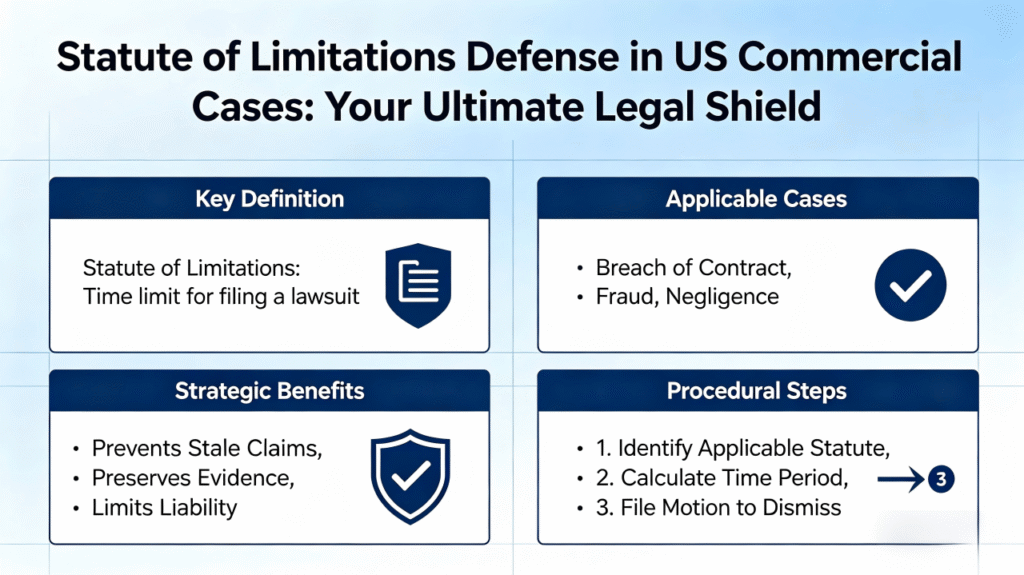
Imagine this: You run a successful business. One quiet Tuesday morning, a process server drops a bombshell on your desk—a lawsuit over a business deal that happened five years ago. Your heart races. You panic. But then, your lawyer smiles and says two magical words: *”Statute of limitations.”* Just like that, the case is thrown out.
In the high-stakes world of US commercial litigation, the **statute of limitations defense** is the ultimate legal shield. It’s the legal system’s way of saying, “Sorry, you snooze, you lose.” But while the concept is simple, the execution is anything but.
Whether you are a US business owner, a foreign investor, or an in-house counsel, understanding how to use this defense can save your company millions of dollars and countless sleepless nights. Let’s break down everything you need to know in plain English.
## 1. What Exactly is the “Statute of Limitations”?
Think of the statute of limitations (SoL) as an expiration date on a carton of milk—except instead of milk, it’s the plaintiff’s right to sue you.
In every US state, statutes of limitations set strict deadlines for filing different types of civil lawsuits. Once that time limit passes, the defendant (you) can raise the SoL as an absolute defense. If you do it right, the court will dismiss the case entirely, no matter how guilty you might actually be.
**The Core Logic:** The legal system wants disputes resolved while evidence is fresh and memories are reliable. If a business partner waits five years to sue you over a breached contract, their memory is likely fuzzy, and your paperwork might be in a storage unit in Arizona. The law cuts them off to ensure fairness.
—
## 2. The Ticking Clock: Time Limits for Common Commercial Claims
Here’s where things get tricky: **There is no single federal law for commercial statutes of limitations.** Instead, each of the 50 states sets its own deadlines. However, most states follow similar patterns for common commercial disputes.
*(Note: Always check the specific state law where your contract was signed or where the dispute arose. The examples below are generalizations.)*
* **Breach of Written Contract:** Typically **3 to 6 years**. (e.g., New York is 6 years; California is 4 years).
* **Breach of Oral Contract:** Usually **2 to 3 years**. Proving an oral agreement is hard enough; proving it years later is nearly impossible, hence the shorter window.
* **Fraud / Misrepresentation:** Generally **3 to 6 years**. This includes business scams, financial deception, or lying on a balance sheet.
* **Debt Collection:** Usually mirrors written contracts (**3 to 6 years**), though some states have specific rules for credit card debts or promissory notes.
* **Tortious Interference:** Typically **2 to 3 years**. (When someone intentionally sabotages your business contract).
**The Bottom Line:** If you are sued for breach of a written contract signed in 2018, and your state’s limit is 4 years, any competent lawyer can have that case tossed out in 2024.
—
## 3. When Does the Clock Actually Start? (The “Accrual” Trap)
You might think, *”The contract was signed in 2018, so the clock started then.”* Not necessarily. In US law, the clock usually starts ticking when the breach **actually occurs** or when the injury is **discovered**.
This leads us to two critical concepts:
### The Standard Rule: Injury Occurs
If you promised to deliver 1,000 widgets by December 1st and didn’t deliver, the clock starts ticking on December 2nd.
### The “Discovery Rule” Exception
What if a business partner embezzled money from your joint venture, but hid it so well that you didn’t find out for three years? In many states, the statute of limitations for fraud doesn’t start until you *reasonably discover* the fraud.
**Why this matters to you:** Plaintiffs will argue the clock hasn’t started yet (or has just started), while you will argue it started years ago. This “battle of the dates” is where many commercial cases are won or lost.
—
utside the statute of limitations? Contact our office today for a confidential consultation.*