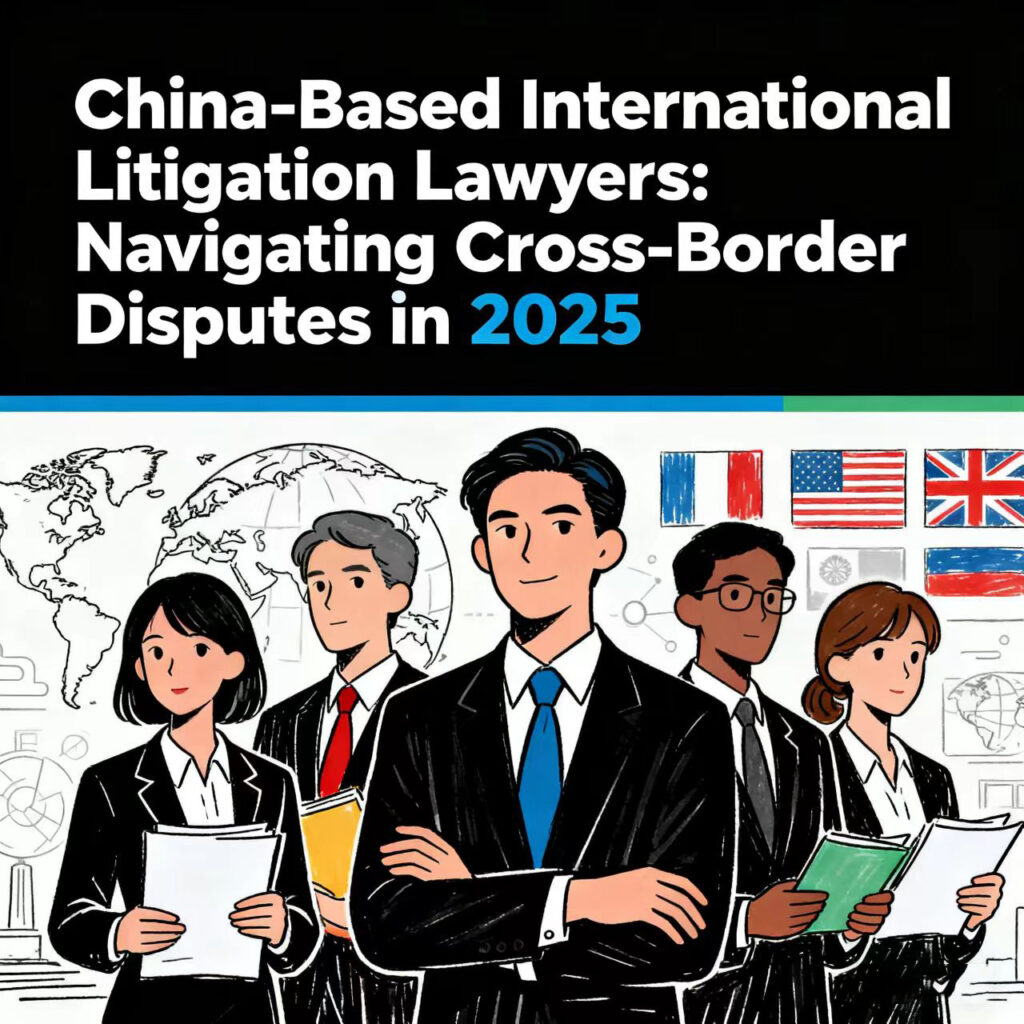
The role of China-based international litigation lawyers has evolved from legal advisors to strategic partners in global business. As geopolitical tensions and cross-border disputes intensify, these professionals combine expertise in Chinese law with fluency in international regulations to protect clients in complex multi-jurisdictional cases. Here’s how they are reshaping the landscape of cross-border legal strategy in 2025.
1. The Unique Value of China-Based International Litigation Lawyers
China-based lawyers specializing in international litigation possess distinct advantages:
– Dual Jurisdictional Expertise: Many are licensed in both China and key international jurisdictions (e.g., New York, Hong Kong), enabling them to navigate civil law and common law systems seamlessly .
– Cultural and Linguistic Fluency: They bridge communication gaps between Chinese clients and foreign courts, ensuring nuanced interpretation of contracts, evidence, and legal precedents .
– Strategic Resource Integration: Lawyers like Liu Xiangwen (Zhong Lun Law Firm) pioneered the “Tell One Story” strategy—maintaining consistent case narratives across jurisdictions to counter procedural fragmentation and bias .
Example: In the Wahaha vs. Danone dispute, Chinese lawyers coordinated 52 parallel cases across six countries, securing a landmark victory by aligning legal arguments in U.S. federal courts, Hong Kong arbitrations, and European proceedings .
2. Key Challenges in Cross-Border Litigation
A. Jurisdictional Complexity
Cases often involve parallel proceedings in multiple countries. For instance, a U.S. patent lawsuit might trigger a countersuit in a Chinese court, requiring lawyers to synchronize strategies across jurisdictions .
B. Geopolitical Influences
U.S.-China tensions have led to heightened scrutiny of Chinese entities in Western courts. Lawyers must mitigate risks like economic sanctions or export control allegations by preemptively structuring transactions to comply with both jurisdictions .
C. Enforcement Hurdles
Even with a favorable judgment, enforcing awards abroad remains challenging. Success depends on leveraging treaties like the New York Convention while navigating local political barriers .
3. Case Studies: Strategic Wins in 2024–2025
A. Indian Metro Project Tax Dispute (2025)
– Issue: An Indian client refused to reimburse $1.8 million in import taxes to a Chinese contractor, violating bid agreement terms .
– Strategy: The Chinese legal team, led by Huang Xueshan, collaborated with local Indian counsel to present a unified case to the Dispute Review Board (DRB), emphasizing contractual obligations under international funding agency rules .
– Outcome: The DRB ruled in favor of the Chinese contractor, setting a precedent for enforcing bid documents as binding contracts .
B. U.S.-China Semiconductor Trade Secrets Litigation (2024)
– Issue: A U.S. firm accused a Chinese company of stealing patented plasma source technology .
– Strategy: The Chinese legal team challenged jurisdiction in U.S. courts while filing a countersuit in Beijing for trade secret misappropriation, creating leverage for a settlement .
– Outcome: The case settled with cross-licensing agreements, avoiding protracted litigation .
C. Russian Arbitration Enforcement in China (2024)
– Issue: A Russian company sought to enforce a $110,000 arbitral award against a Chinese firm in Xiamen .
– Strategy: Lawyers Tan Yueqi and Peng Xiaoen leveraged the New York Convention to prove reciprocity between China and Russia, streamlining the enforcement process .
– Outcome: The Xiamen International Commercial Court recognized the award, marking the first enforcement of a BRICS country’s arbitration verdict in China .
4. Evolving Trends Demanding Specialized Skills
Trend Impact on Lawyers Example
Rise of Anti-Sanctions Cases Defending clients against U.S. CFIUS reviews or EU trade barriers requires expertise in sanction regimes . Chen Xiao assisted a新能源 firm in avoiding U.S. sanctions by restructuring supply chains .
Data Localization Conflicts Navigating China’s PIPL vs. GDPR/CCPA conflicts in cross-border data transfers . Fei Jia designed compliance frameworks for tech firms to satisfy both regimes .
Third-Country Arbitration Using neutral venues (e.g., Singapore) to bypass jurisdictional bias . Chen Fayun often arbitrates in SIAC or HKIAC for China-EU disputes .
5. How These Lawyers Mitigate Risks
1. Proactive Compliance Structuring
– Pre-litigation audits of contracts/IP portfolios to identify vulnerabilities .
– Example: Wang Dakun’s “real-time monitoring + expert team” system helps clients avoid FCPA violations .
2. Integrated Cross-Border Teams
– Pairing China-based lead counsel with local lawyers in foreign jurisdictions ensures cultural and procedural alignment .
3. Strategic Forum Selection
– Advising clients on filing cases in friendlier jurisdictions (e.g., Hong Kong for common law matters) .
6. The Future: AI, Geopolitics, and New Specializations
– AI-Powered Litigation Tools: Lawyers like Wang Xuanjun use AI to predict case outcomes based on historical rulings in U.S.-China disputes .
– Expansion into ESG and Carbon Compliance: As sustainability regulations tighten, lawyers advise on cross-border carbon tax litigation and green technology IP .
– Defensive Patent Strategies: Preemptive patent filings in both CNIPA and USPTO to block frivolous infringement claims .
Conclusion: The Indispensable Bridge in Global Disputes
“In 2025, China-based international litigation lawyers are not just legal representatives—they are strategic assets who turn jurisdictional complexity into competitive advantage.”
Key Takeaways:
– Dual-licensed lawyers (e.g., those qualified in China and the U.S.) outperform single-jurisdiction counsel in reducing costs and delays .
– Success hinges on cultural fluency—understanding guanxi (关系) networks and Western legal formalities alike .
– Proactive risk management, such as pre-dispute arbitration clauses, is critical for avoiding geopolitical entanglements .
For businesses operating between China and global markets, investing in specialized local counsel is no longer optional but essential to navigate the intricate web of modern cross-border litigation.
For further insights, refer to ongoing case analyses by the Beijing International Commercial Court and the Hong Kong International Arbitration Centre.