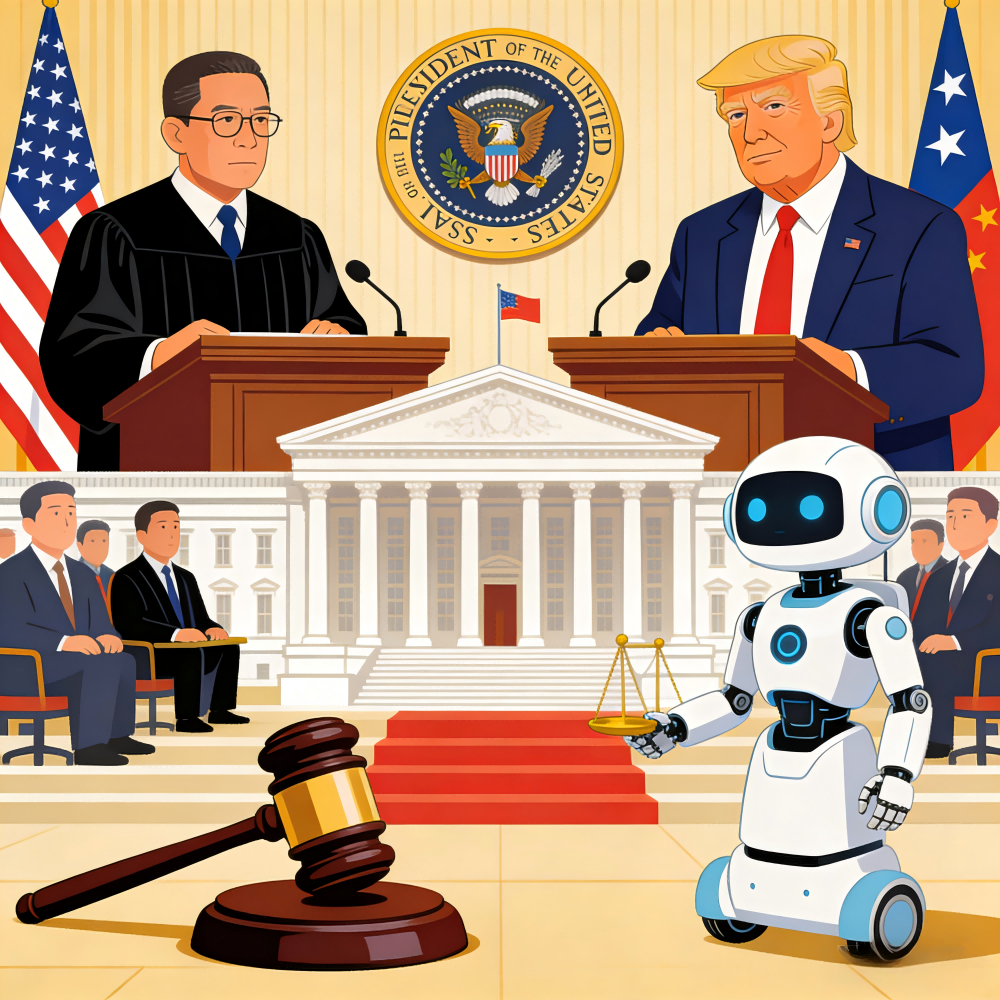
A New Front in China-US Tech Competition
The **high-stakes battle** over intellectual property between China and the United States has entered a dramatic new phase with **Hollywood’s biggest studios** taking aim at one of China’s most promising AI startups. In September 2025, Disney, Universal, and Warner Bros. filed a landmark lawsuit against Chinese AI company MiniMax, alleging systematic copyright infringement on an unprecedented scale. This case represents the latest escalation in **sophisticated IP litigation** between the two economic powers, with potentially far-reaching implications for the global technology and entertainment industries .
This lawsuit is not an isolated incident but part of a broader pattern of increasing intellectual property disputes between Chinese and American entities. From semiconductor patents to entertainment copyrights, the battleground has expanded to encompass virtually every sector where technological innovation drives competitive advantage. The MiniMax case exemplifies how emerging technologies like generative AI are testing the boundaries of existing IP frameworks and creating new friction points in China-US relations .
## The MiniMax Case: Hollywood’s “Copyright Nuclear Option”
The lawsuit against MiniMax, filed in the U.S. District Court for the Central District of California, alleges that the company’s “Hailuo AI” (海螺AI) service enables users to generate images and videos featuring **copyrighted characters** such as Disney’s Darth Vader from Star Wars, Marvel’s Spider-Man, and Universal’s Minions from Despicable Me. The 119-page complaint describes MiniMax’s business model as being built on “massive piracy and misappropriation” of Hollywood’s most valuable intellectual property .
What makes this case particularly significant is the **coordinated action** by multiple major studios. The plaintiff group includes 12 entertainment companies representing Disney, Marvel, Lucasfilm, 20th Century Fox, Universal, DreamWorks, Warner Bros., DC Comics, and Cartoon Network. This united front suggests that Hollywood views generative AI not just as a legal nuisance but as an **existential threat** to the $260 billion American entertainment industry .
The studios allege that MiniMax has positioned its service as a “pocket Hollywood studio,” allowing users to create content featuring protected characters with simple text prompts. The complaint includes numerous examples of generated content, such as “Darth Vader walking on the Death Star holding a red lightsaber” and “Bart Simpson skateboarding on the street,” with side-by-side comparisons showing striking similarities to the original copyrighted characters .
## Beyond Entertainment: Broader Trends in China-US IP Litigation
The MiniMax case unfolds against a backdrop of increasingly sophisticated IP disputes across multiple sectors. Several notable trends have emerged in 2024-2025:
### 1. Strategic Patent Challenges
Chinese companies are becoming more sophisticated in their approach to U.S. patent litigation. The case of Innoscience, a Chinese GaN semiconductor manufacturer, demonstrates this evolution. When faced with a Section 337 investigation by the U.S. International Trade Commission (ITC) in 2023, Innoscience pursued a **multi-pronged strategy** that included challenging the validity of the asserted patents through the U.S. Patent and Trademark Office’s inter partes review (IPR) process. This “undermine the foundation” approach proved successful when the USPTO declared the plaintiff’s patent invalid in March 2025, effectively dismantling the case against the Chinese company .
### 2. University-NPE Collaboration Challenges
Chinese tech companies face growing threats from **patent assertion entities (NPEs)** that collaborate with American universities. In August 2025, Lenovo was sued by Empire Technology Development LLC, a U.S. NPE that had acquired patents from the University of Texas system. This “university-NPE collaboration model” allows plaintiffs to bypass standard licensing frameworks while leveraging academic research credibility. For Chinese technology companies with significant U.S. market presence, this represents a particularly challenging form of litigation because the patents often cover fundamental technologies that are difficult to design around .
### 3. Trade Secrets Battles Intensify
Trade secret cases have taken on greater significance with increasingly severe consequences for losing defendants. In a landmark 2025 ruling, the ITC imposed a **14-year, 8-month import ban** on OLED panels from a Chinese display manufacturer found to have misappropriated trade secrets from Samsung Display. The extraordinary duration of this exclusion order—covering multiple product lifecycles—signals a hardening approach to intellectual property enforcement that could significantly impact Chinese manufacturers in technology-intensive sectors .
## Statistical Landscape: Quantifying the Litigation Boom
Recent data reveals the escalating scale of China-US intellectual property disputes. According to the 2024 Annual Report on Chinese Companies’ Overseas Intellectual Property Disputes, Chinese entities were involved in **1,227 new intellectual property cases** in the United States in 2024 alone. This included 587 patent cases, 668 trademark cases, and 16 trade secret cases. Perhaps more significantly, Chinese companies faced 24 Section 337 investigations before the ITC, 95.83% of which involved patent infringement allegations .
The financial stakes are substantial. Patent litigation resulted in an **average damages award** of $2.803 million, while trademark cases averaged $251,000. In the realm of e-commerce, Chinese companies were defendants in 1,165 cross-border IP cases, representing 89.48% of all such litigation .
Geographic patterns are also evident. Companies from Guangdong, Zhejiang, and Fujian provinces accounted for the majority of Chinese entities involved in U.S. IP litigation, with Guangdong-based companies alone comprising nearly 30% of all cases. The industries most frequently targeted included electronics, electrical machinery, and equipment manufacturing .
## Defense Strategies Evolve as Chinese Companies Adapt
Facing this litigation wave, Chinese companies have developed increasingly sophisticated response strategies:
### 1. Procedural Counteroffensives
Rather than simply defending against allegations, Chinese companies are more frequently launching **procedural challenges** against the validity of asserted patents. The Innoscience case exemplifies this approach, where instead of merely arguing non-infringement in the ITC proceeding, the company successfully challenged the fundamental validity of the patent itself through USPTO procedures .
### 2. Multi-Jurisdictional Tactics
Chinese companies are increasingly turning to **global counterclaims** filed in China and other jurisdictions to create leverage in U.S. disputes. When Lenovo faced patent allegations from U.S. NPEs, industry analysts noted that the company could file retaliatory litigation in Chinese courts, potentially forcing settlements more favorable than what might be achieved solely through U.S. legal proceedings .
### 3. Technical and Legal Integration
Successful defense increasingly requires **deep integration** of technical expertise and legal strategy. In the landmark case where a Chinese LED manufacturer successfully defended against trade secret allegations, the company’s legal team spent three months thoroughly analyzing the disputed technology and developed 13 specific trade secret points across five categories. This technical precision proved decisive when the Hong Kong International Arbitration Centre ruled in the Chinese company’s favor, awarding $1.07 million in damages .
## Sector Spotlight: AI and Content Industries at the Forefront
The MiniMax case highlights particular tensions in the artificial intelligence sector, where U.S. and Chinese companies are competing for global leadership. Generative AI companies like MiniMax rely on **large-scale training data**,- which often includes copyrighted material. The lawsuit alleges that MiniMax deliberately ignored copyright protections that other AI providers had implemented, choosing instead to build its business on what plaintiffs characterize as “willful and rampant” infringement .
This case may establish important precedents regarding how **copyright principles** apply to AI training data and output. The plaintiffs argue that MiniMax’s ability to filter out other types of problematic content (such as violence or nudity) demonstrates that the company could implement copyright protections but has deliberately chosen not to do so .
The outcome could significantly impact the development trajectory of generative AI globally. If U.S. courts impose substantial penalties or injunctions requiring extensive content filtering, Chinese AI companies may face competitive disadvantages compared to U.S. counterparts that have already implemented more robust copyright compliance systems .
## Regional Patterns: Guangdong and Zhejiang Companies in the Crosshairs
Statistical analysis reveals that Chinese companies from **specific regions** bear disproportionate exposure to U.S. intellectual property litigation. Companies from Guangdong Province accounted for approximately 30% of all Chinese entities involved in U.S. IP cases in 2024, followed by Zhejiang and Fujian provinces. This concentration reflects the export-oriented economic structures of these coastal regions .
The phenomenon is particularly pronounced in **e-commerce disputes**, where Chinese sellers on platforms like Amazon frequently face trademark allegations. In one notable pattern, U.S. law firms have developed systematic approaches to identifying potential infringement by Chinese sellers, filing batch lawsuits against dozens or even hundreds of defendants simultaneously. Many small Chinese merchants default in these cases, calculating that the cost of mounting a U.S. legal defense exceeds the amount being claimed .
## Conclusion: An Evolving Landscape with High Stakes
The escalating intellectual property litigation between Chinese and American entities reflects broader **technological competition** and shifting economic dynamics. As Chinese companies move up the value chain from manufacturing to innovation, they increasingly encounter IP regimes that were largely designed by and for Western companies. The resulting friction creates both challenges and opportunities for legal systems and businesses in both countries .
The MiniMax case may prove to be a **watershed moment** in this evolving landscape. Its resolution could establish important precedents regarding how intellectual property laws apply to generative AI technologies that are expected to drive significant economic value in the coming decades. For Hollywood studios and AI companies alike, the outcome will help determine the rules governing the use of copyrighted content in training data and the boundaries of AI-generated output .
What is clear is that intellectual property has become a central battleground in China-US economic relations. As one analysis noted, “When MiniMax’s Hailuo AI can allow ordinary users to generate anime characters comparable to Hollywood productions with one click, copyright holders not only lose licensing revenue but also face the risk of brand dilution.” This fundamental tension between disruptive innovation and established rights holders ensures that IP litigation will remain a key feature of the China-US relationship for the foreseeable future .
For companies operating across this landscape, the evolving litigation environment demands more sophisticated approaches to intellectual property management, including earlier patent landscaping, more robust compliance systems, and prepared response strategies for when disputes inevitably arise. The companies that thrive will be those that successfully navigate both the technological and legal complexities of today’s global innovation economy .
—
*This analysis synthesizes recent developments in China-US intellectual property litigation, with a focus on the landmark case brought by Hollywood studios against Chinese AI company MiniMax and broader trends in cross-border IP disputes.*