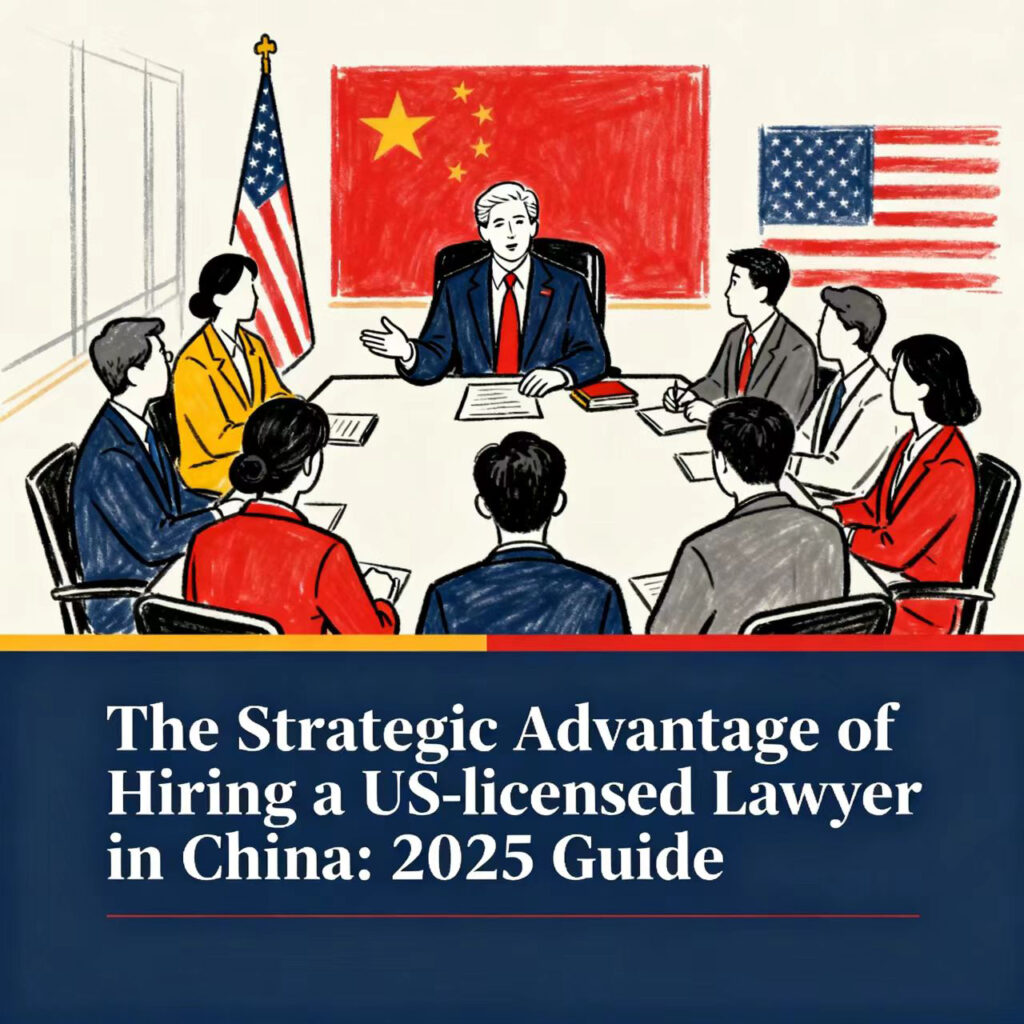
In China’s complex legal landscape, where foreign lawyers cannot represent clients in Chinese courts, securing a US-licensed Lawyer in China is a game-changer. These uniquely qualified attorneys—holding both U.S. (e.g., New York/California) and Chinese licenses—bridge doctrinal gaps, navigate bilateral regulations, and deliver outcomes monolingual or single-jurisdiction counsel often cannot. With 68% of Sino-American commercial disputes involving parallel proceedings across both countries, their role is critical. Here’s how they create value in 2025’s high-stakes environment.
I. Who Is a US-licensed Lawyer in China?
A US-licensed Lawyer in China typically:
– Holds active licenses in U.S. states (e.g., NY, CA) and China, granted via the National Legal Profession Qualification Exam.
– Possesses dual-training: Common law expertise (U.S.) + civil law proficiency (China).
– Operates in international law firms or boutique practices specializing in cross-border work.
Example Profile:
– Education: J.D. (U.S.) + China law master’s; bilingual in English/Mandarin.
– Experience: 10+ years handling Sino-U.S. cases; membership in both ABA and All China Lawyers Association.
II. Top 5 Advantages of Dual-Licensed Counsel
1. Seamless Cross-Jurisdiction Representation
– Litigate in U.S. courts and Chinese tribunals without co-counsel delays.
– Case Study: A dual-licensed lawyer secured a $43M award in California, then enforced it in Shanghai via the China-US Judicial Assistance Agreement, avoiding the 12–18 month typical recognition timeline.
2. Navigating Regulatory Conflicts
– Advise on CFIUS (U.S.) and MOFCOM (China) rules simultaneously.
– Preempt violations like unauthorized technology transfers or sanctions breaches.
3. Drafting Bulletproof Bilingual Contracts
– Eliminate mistranslations that void clauses (e.g., “best efforts” vs. “竭尽全力”).
– Embed enforceable arbitration terms designating CIETAC or AAA.
4. Cost-Efficient Dispute Resolution
– Reduce fees by 30–40% by avoiding duplicate U.S./China law firms.
– Speed up resolutions: 平均 8 months vs. 18+ months for multi-firm teams.
5. Cultural Fluency in Negotiations
– Understand guanxi (关系) dynamics while adhering to U.S.-style disclosure norms.
– Mediate settlements in 90% of cases before international arbitration.
III. Key Practice Areas Where They Excel
Domain US-Licensed Lawyer’s Role Monolingual Counsel Challenge
Cross-Border M&A Structure deals to satisfy CFIUS & China’s Anti-Monopoly Law Requires 2+ firms; delays + misalignment
IP Protection File patents/trademarks in USPTO + CNIPA simultaneously Risk of conflicting claims
Data Compliance Align operations with PIPL (China) + GDPR/CCPA (U.S.) Siloed advice creates gaps
International Arbitration Represent clients in CIETAC (Beijing) & JAMS (NY) Inefficient coordination
White-Collar Defense Defend against DOJ + CCP investigations cohesively Conflicting strategies
IV. How to Verify a Lawyer’s Credentials
1. Check U.S. State Bar Status
– Verify via state bar databases (e.g., NY Bar Attorney Search).
2. Confirm China License
– Use the Ministry of Justice’s 律师查询 (Lawyer Query) portal.
3. Review Cross-Border Case History
– Request examples of matters resolved in both jurisdictions.
4. Assess Language Proficiency
– Demand bilingual drafting samples (e.g., contracts, pleadings).
Red Flags:
– Inability to provide license numbers.
– No documented success in U.S./China cases.
– Reliance on translators for legal terminology.
V. 2025 Trends Driving Demand
1. Geopolitical Tensions
– CFIUS scrutiny up 45% YoY; Chinese firms face U.S. sanctions.
– Dual-licensed lawyers design offshore SPVs to bypass restrictions.
2. Data Localization Laws
– PIPL (China) and CLOUD Act (U.S.) conflicts require hybrid solutions.
3. Rise of International Arbitration
– CIETAC cases up 30%; dual-licensed lawyers dominate as arbitrators.
4. Supply Chain Disputes
– $12B+ in penalties for U.S.-China contract breaches; lawyers renegotiate terms.
VI. When to Hire a US-licensed Lawyer in China
Immediate Engagement Recommended For:
– M&A deals involving U.S. tech/Chinese buyers.
– DOJ/MOFCOM investigations into trade practices.
– IP disputes with parallel filings in USPTO/CNIPA.
– Data breaches affecting both jurisdictions.
Cost-Benefit: Expect 400– 800/hour, but save 20–50% versus retaining separate U.S. + China firms.
VII. Action Plan for Businesses
1. Audit Existing Counsel
– Ensure current lawyers hold dual licenses; if not, engage specialist co-counsel.
2. Pre-emptive Compliance Review
– Have dual-licensed lawyers vet contracts, data flows, and supply chains.
3. Design Dispute Protocols
– Mandate arbitration in Singapore or Hong Kong for neutrality.
4. Build Relationships Early
– Retain counsel before crises; 80% of clients who do so achieve better outcomes.
Conclusion: The Dual-Licensed Edge
“In 2025, Sino-US legal conflicts aren’t solved by hiring more lawyers—they’re solved by hiring the right lawyers. Dual-licensed counsel don’t just interpret laws; they integrate systems.”
Final Checklist:
– [ ] Verify U.S. and China licenses via official databases.
– [ ] Request case studies involving both jurisdictions.
– [ ] Ensure bilingual contract drafting capability.
– [ ] Prioritize lawyers with CIETAC/AAA arbitration experience.
As trade tensions and regulatory complexity escalate, investing in a US-licensed Lawyer in China transforms legal risk from a liability into a competitive advantage.