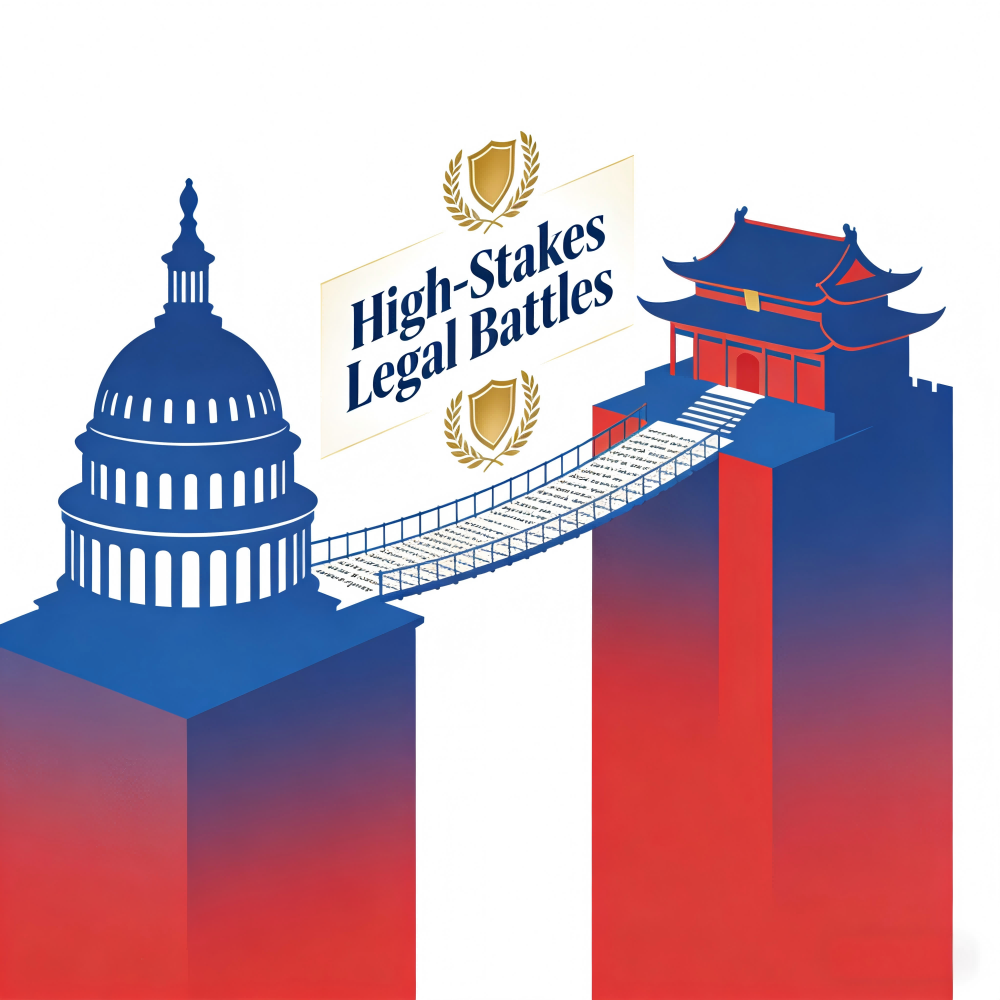
In an era of intensifying cross-border trade disputes, Chinese companies face mounting risks of **US commercial litigation**, including patent infringement, antitrust claims, and contract breaches. These cases often involve complex legal frameworks, high stakes, and the potential for crippling sanctions. This comprehensive guide explores actionable defense strategies, case studies, and risk mitigation tactics tailored to Chinese enterprises navigating US courtrooms.
## Understanding the Legal Landscape
### 1. **Key Legal Frameworks**
– **337 Investigations**: Governed by the *Tariff Act of 1930*, these investigations target alleged patent, trademark, or copyright infringement in imported goods. ITG’s 2025 case against Chinese eyewear firms highlights the speed and severity of 337 actions .
– **Antitrust Laws**: The *Sherman Act* and *Clayton Act* are frequently invoked in price-fixing or market allocation cases. The 17-year vitamin C antitrust battle (2005–2022) underscores the risks of alleged collusion .
– **Intellectual Property (IP) Litigation**: Patent trolls and competitors often leverage US courts to challenge Chinese tech innovations. In 2023, Shenzhen-based firms saw a 38% rise in patent lawsuits .
– **Foreign Sovereign Immunity**: State-owned enterprises (SOEs) may invoke *28 U.S.C. § 1605* to claim immunity, as seen in cases like *Rainbow CRT* (2018) .
### 2. **Common Risks**
– **Jurisdictional Challenges**: US courts may assert jurisdiction over foreign entities via “minimum contacts” (e.g., online sales to US customers) .
– **Costly Discovery**: Protracted evidence gathering can drain resources, especially for SMEs.
– **Enforcement Risks**: Default judgments can trigger asset seizures or exclusion orders under *28 U.S.C. § 1610* .
—
## Defense Strategies for Chinese Companies
### 1. **Preemptive Risk Mitigation**
– **Contractual Safeguards**: Include arbitration clauses (e.g., ICC or CIETAC) and forum-selection provisions to avoid US courts .
– **IP Portfolios**: Proactively file patents in the US and monitor competitors’ filings. Shenzhen’s 2023 patent litigation surge highlights the need for robust IP strategies .
– **Compliance Programs**: Establish export controls and anti-corruption policies to align with US regulations (e.g., FCPA).
### 2. **Jurisdictional Challenges**
– **Argue Lack of Minimum Contacts**: Cite cases like *Shanghai Yongrun* (2022), where procedural flaws in service of process led to dismissal .
– **Foreign Sovereign Immunity**: For SOEs, demonstrate government ownership and lack of “commercial activity” in the US .
### 3. **Patent Defense Tactics**
– **Invalidation Campaigns**: File post-grant reviews (PGRs) or inter partes reviews (IPRs) to challenge patent validity. For example, Huasix successfully invalidated NOCO’s patents in 2022 .
– **Design-Around Innovations**: Modify products to avoid infringing claims. Dajiang’s response to 2025’s 337 investigation involved redesigning charging systems .
### 4. **Antitrust Defense**
– **Evidence of Market Competition**: Demonstrate pricing autonomy and lack of collusion. The vitamin C case (2022) relied on Chinese regulatory requirements to refute antitrust claims .
– **Government Backing**: Leverage China’s Ministry of Commerce as an *amicus curiae* to explain domestic policies .
### 5. **Collective Action Defense**
– **Identify “Troll” Patterns**: Analyze plaintiff litigation histories to expose frivolous claims. For ADA-related lawsuits, investigate whether the plaintiff files bulk cases .
– **Negotiate Settlements**: Prioritize confidential settlements to avoid precedent-setting rulings.
—
## Case Studies: Lessons from High-Profile Litigation
### 1. **Case 1: Huasix vs. NOCO (2022)**
– **Issue**: Alleged infringement of NOCO’s emergency power patents.
– **Defense**:
– Filed IPRs to invalidate 22 patent claims.
– Launched parallel litigation in Germany and Canada.
– **Outcome**: ITG terminated the 337 investigation; NOCO withdrew claims .
### 2. **Case 2: BAIC vs. Tesla (2023)**
– **Issue**: Patent dispute over EV battery technology.
– **Defense**:
– Demonstrated prior art in Chinese filings.
– Secured support from the China Association of Automobile Manufacturers.
– **Outcome**: Settlement with royalty-sharing agreement .
### 3. **Case 3: Vitamin C Antitrust (2022)**
– **Issue**: Alleged price-fixing by Chinese manufacturers.
– **Defense**:
– Argued compliance with Chinese export controls.
– Secured amicus briefs from the Chinese government.
– **Outcome**: Supreme Court reversed $150M judgment .
## Emerging Trends and Risks
### 1. **Geopolitical Pressures**
– US-China tech decoupling may increase scrutiny of Chinese IP. Courts may scrutinize Chinese government links to SOEs .
### 2. **Digital Privacy Laws**
– CIPA and CCPA lawsuits target data collection practices. In 2023, a Chinese app developer settled a $2.1M CIPA claim for unauthorized tracking .
### 3. **Supply Chain Transparency**
– Laws like the *Uyghur Forced Labor Prevention Act* (UFLPA) require documentation to prove ethical sourcing.
—
## Practical Checklist for Defense Preparation
1. **Audit Compliance**: Review contracts, IP portfolios, and export controls.
2. **Build a Legal Network**: Partner with US and Chinese attorneys specializing in cross-border litigation.
3. **Monitor Legal Alerts**: Track 337 investigations and antitrust developments via platforms like PACER.
4. **Crisis Management**: Establish a 24/7 response team for litigation triggers.
—
## Conclusion: Balancing Compliance and Strategy
Chinese companies face a dual imperative: defending against US litigation while safeguarding global operations. By combining proactive risk management, strategic litigation tactics, and leveraging geopolitical trends, businesses can mitigate exposure and protect their interests. As geopolitical tensions evolve, adaptability and cross-border legal expertise will remain critical.